
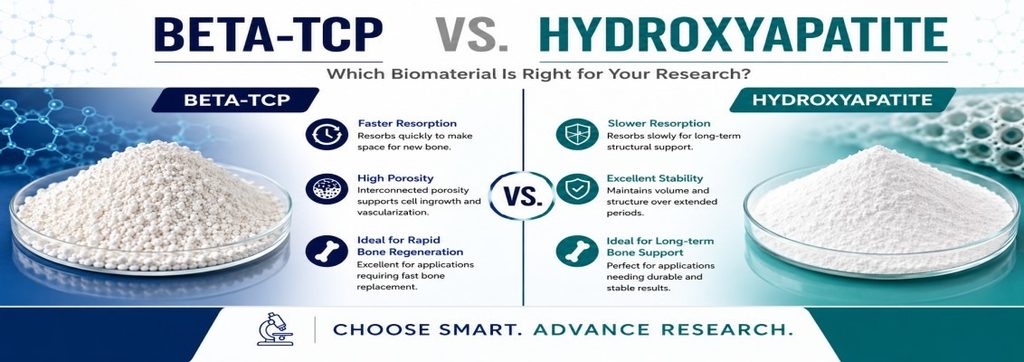
Beta-TCP vs. Hydroxyapatite: Which Biomaterial Is Right for Your Research?
Selecting the right biomaterial is a critical decision in bone regeneration, tissue engineering, and biomedical research. Among the most widely studied calcium phosphate materials, Beta-Tricalcium Phosphate (β-TCP) and Hydroxyapatite (HA) have gained significant attention due to their biocompatibility, osteoconductive properties, and potential applications in bone repair.
At Medoja Bio, researchers can explore advanced biomaterial solutions designed to support innovation in regenerative medicine. Understanding the differences between Beta-TCP and Hydroxyapatite helps researchers select the ideal material based on their project goals, scaffold requirements, and regeneration needs.
What Is Beta-TCP?
Beta-Tricalcium Phosphate (β-TCP) is a biodegradable calcium phosphate biomaterial widely used in bone graft substitutes and tissue engineering applications. It supports new bone formation by providing a porous structure where bone-forming cells can attach and grow.
One of the key advantages of β-TCP is its controlled resorption rate. The body gradually breaks down the material and replaces it with newly formed bone tissue. This property makes the material suitable for applications requiring temporary structural support during healing.
Researchers often prefer Beta-TCP for:
- Bone defect repair studies
- Regenerative medicine research
- Tissue engineering scaffolds
- Injectable bone substitute development
What Is Hydroxyapatite?
Hydroxyapatite (HA) is a naturally occurring calcium phosphate mineral that closely resembles the inorganic component of human bone. Researchers widely investigate hydroxyapatite for bone implants, coatings, and regenerative applications because it offers excellent biocompatibility and closely resembles the chemical composition of natural bone.
Unlike β-TCP, Hydroxyapatite has a slower degradation rate, allowing it to provide long-term structural stability. Its strong osteoconductive properties help support bone cell attachment and mineralization around the material.
Hydroxyapatite is commonly researched for:
- Bone scaffold development
- Dental and orthopedic applications
- Implant coatings
- Long-term bone regeneration studies
Beta-TCP vs Hydroxyapatite: Key Differences
1. Resorption Rate
The biggest difference between β-TCP and Hydroxyapatite is their degradation behavior.
Beta-TCP is more biodegradable and gradually dissolves as new bone forms. This makes it suitable for applications requiring faster material replacement.
Hydroxyapatite is more stable and remains in the body for a longer duration, making it beneficial when long-term support is required.
2. Bone Regeneration Ability
Both materials support bone growth, but their mechanisms differ.
β-TCP encourages bone regeneration by allowing gradual replacement with natural bone tissue. Hydroxyapatite provides a stable surface that promotes cell attachment and mineral formation.
Many advanced studies also explore combined HA/β-TCP materials to achieve balanced resorption and regeneration properties.
3. Mechanical Properties
Hydroxyapatite generally provides better structural stability because of its slower degradation. However, it can be brittle due to its ceramic nature.
Beta-TCP degrades more effectively within the body. However, applications requiring greater mechanical strength may need composite designs or material modifications.
Which Biomaterial Is Right for Your Research?
The choice between Beta-TCP and Hydroxyapatite depends on your research objective.
Choose Beta-TCP when:
- Faster biodegradation is required
- Temporary scaffold support is needed
- New bone replacement is the primary goal
Choose Hydroxyapatite when:
- Long-term stability is important
- Strong bone-like mineral properties are required
- Implant coating or structural applications are being studied
For advanced research projects, combining both materials can provide the benefits of each. Biphasic calcium phosphate materials containing Hydroxyapatite and β-TCP are increasingly studied because they balance stability with controlled resorption.
Why Choose Medoja Bio for Biomaterial Research?
Medoja Bio focuses on providing high-quality biomaterial solutions for researchers working in bone regeneration, tissue engineering, and regenerative medicine. With reliable biomaterials and research-focused support, Medoja Bio helps scientists develop innovative solutions for future healthcare advancements.
Whether your research requires Beta-TCP, Hydroxyapatite, or advanced calcium phosphate-based materials, selecting the right biomaterial can significantly influence study outcomes.
Conclusion
Both Beta-TCP and Hydroxyapatite play important roles in modern biomaterial research. While β-TCP offers faster resorption and replacement potential, Hydroxyapatite provides excellent stability and bone-like properties. The ideal choice depends on your specific research requirements.
Explore advanced biomaterial solutions with Medoja Bio and take your bone regeneration research to the next level.