
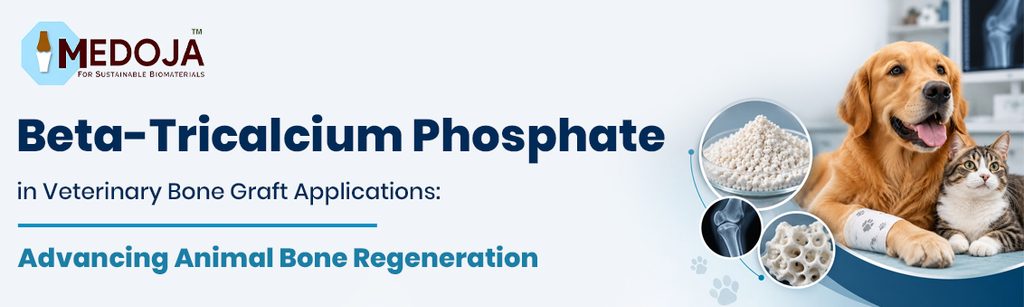
Beta-Tricalcium Phosphate in Veterinary Bone Graft Applications
Bone injuries, fractures, and defects are common challenges in veterinary medicine, affecting companion animals, livestock, and other animal species. Successful bone healing requires materials that can support new bone formation while providing structural stability. Beta-Tricalcium Phosphate (β-TCP) has become an important synthetic bone graft material because it offers excellent biocompatibility and osteoconductive properties. It gradually resorbs as the body forms new natural bone.
β-TCP is a calcium phosphate ceramic that closely resembles the mineral composition of natural bone. Its unique properties make it suitable for various veterinary orthopedic and dental applications, helping veterinarians manage complex bone defects and improve recovery outcomes in animals.
What is Beta-Tricalcium Phosphate (β-TCP)?
Beta-Tricalcium Phosphate is a synthetic calcium phosphate compound with the chemical formula Ca₃(PO₄)₂. It is widely used as a bone substitute because it provides a supportive framework for bone cells to attach, grow, and form new tissue.
Unlike permanent implants, β-TCP gradually breaks down inside the body through natural biological processes. As the material is absorbed, it is replaced by newly formed bone, making it a valuable option for regenerative veterinary procedures.
Applications of β-TCP in Veterinary Bone Grafting
1. Treatment of Bone Defects and Fractures
Large bone defects caused by trauma, fractures, infections, or surgical procedures can be difficult to heal naturally. β-TCP graft materials help fill these gaps and provide a three-dimensional scaffold that supports bone regeneration.
Veterinary orthopedic surgeons use β-TCP in dogs, cats, horses, and livestock when natural bone repair is insufficient. It helps support healing after orthopedic surgery.
2. Veterinary Orthopedic Surgery
Orthopedic surgeons use bone graft materials to support healing and stability. They use β-TCP in fracture repair, non-union fracture treatment, and corrective bone surgeries.
Its porous structure allows blood vessels and bone-forming cells to migrate into the graft area, promoting faster integration with surrounding bone tissue.
3. Dental and Maxillofacial Applications
Revised Version:
Dental problems in animals, including jawbone defects and tooth-related bone loss, may require regenerative treatment. In veterinary dentistry, clinicians use β-TCP to support bone formation around dental implants, extraction sites, and periodontal defects.
The material helps restore bone volume and improves the structural support required for successful dental procedures.
4. Spinal and Reconstructive Procedures
In veterinary spinal surgeries and reconstructive procedures, maintaining bone growth and fusion is essential. β-TCP can act as a bone substitute to encourage new bone formation and support long-term healing.
Clinicians may combine β-TCP with other graft materials or biological agents to enhance its regenerative performance.
Advantages of β-TCP in Veterinary Medicine
Excellent Biocompatibility
β-TCP is well tolerated by animal tissues and has a low risk of causing adverse immune reactions.
Osteoconductive Properties
The porous structure provides a pathway for new bone cells and blood vessels to grow, supporting natural healing.
Controlled Resorption
β-TCP gradually dissolves as new bone develops, reducing the need for additional removal surgeries.
Safe Synthetic Alternative
As a synthetic material, β-TCP eliminates concerns related to disease transmission associated with some biological graft materials.
Future Potential of β-TCP in Veterinary Bone Regeneration
Advancements in biomaterials are improving the performance of β-TCP through technologies such as advanced porosity control, surface modifications, and combination therapies with growth factors and stem cells. These developments may further enhance bone regeneration in veterinary applications.
Researchers are also exploring customized β-TCP scaffolds produced through 3D printing technology, allowing personalized solutions for complex animal bone defects.
Conclusion
Beta-Tricalcium Phosphate is becoming an increasingly valuable biomaterial in veterinary bone graft applications due to its safety, regenerative ability, and compatibility with natural bone healing processes. From fracture repair and orthopedic surgery to dental and reconstructive procedures, β-TCP provides veterinarians with an effective solution for supporting bone regeneration.
As biomaterial technology continues to advance, researchers expect β-TCP to improve surgical outcomes and enhance the quality of life for animals requiring bone restoration. Learn more about biomaterial technology.