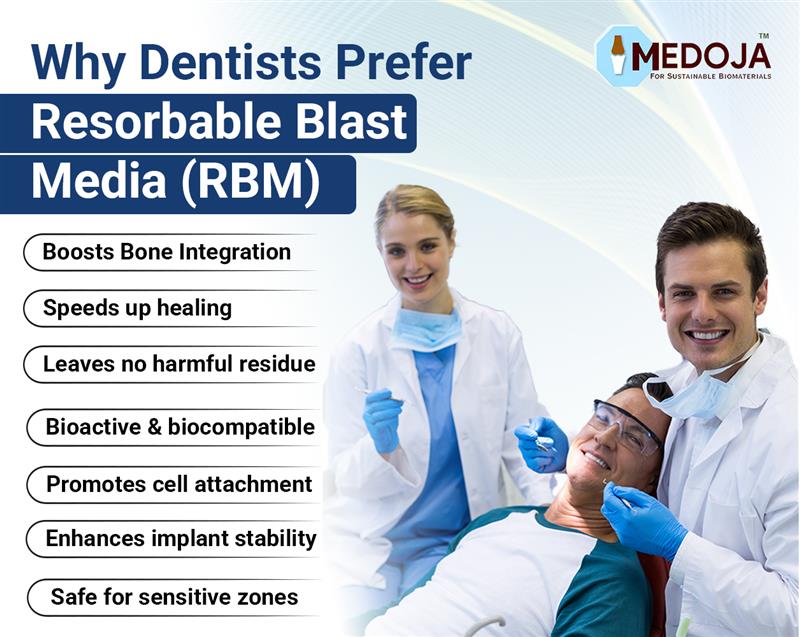
Why Dentists Prefer Resorbable Blast Media for Implants

Why Dentists Prefer Resorbable Blast Media for Implants

Why Dentists Prefer Resorbable Blast Media for Implants

In the field of implant dentistry, achieving optimal osseointegration, the process by which a dental implant fuses with the jawbone, is a cornerstone of long-term clinical success. One critical aspect that influences osseointegration is implant surface preparation. Among various surface treatment techniques, resorbable blast media (RBM) has gained substantial traction due to its biocompatibility, surface enhancement properties, and superior clinical outcomes. But what exactly is resorbable blast media, and why are more and more dental professionals turning to it?  In this article, we will explore the scientific rationale behind the use of RBM in implantology, focusing on how it modifies implant surfaces, enhances bone integration, and outperforms traditional techniques. 

What is Resorbable Blast Media? 

Resorbable blast media (RBM) refers to materials used in the blasting process of dental implant surfaces that are biodegradable and biocompatible. The process, commonly known as implant surface blasting, involves bombarding the implant surface with high-velocity particles to increase surface roughness and improve mechanical interlocking with bone tissue.  What sets RBM apart from traditional media (such as alumina or titanium oxide) is that RBM materials are resorbable by the body. The most widely used resorbable materials include hydroxyapatite (HA), calcium phosphate, and other calcium-based compounds, materials that are naturally found in bone and can dissolve or integrate without causing foreign body reactions. 

The Need for Surface Treatment in Dental Implants 

Dental implants, typically made of titanium or titanium alloys, are naturally biocompatible but inherently smooth. While this smoothness minimizes plaque accumulation, it also limits the bone’s ability to adhere strongly to the implant surface.  To counteract this limitation, various surface modification techniques are employed, including: 
  • Blasting with abrasive media 
  • Acid etching
  • Plasma spraying
  • Anodization
  • Laser texturing
Among these, surface blasting with resorbable materials stands out due to its balance of surface topography optimization and biological compatibility. 

How RBM Works: A Microscopic Advantage 

RBM treatment involves directing micro-particles of resorbable materials at high speeds toward the implant’s surface. This creates a micro-roughened surface topography, characterized by micro pits and irregularities.  Why is this important?  Bone cells, particularly osteoblasts, exhibit enhanced activity when interacting with moderately rough surfaces (Ra = 1–2 µm). Such surfaces: 
  • Promote cell attachment and proliferation 
  • Stimulate differentiation of pre-osteoblasts 
  • Enhance matrix mineralization and bone bonding strength 
RBM-treated implants present an ideal roughness without leaving residual non-biocompatible materials, a common problem with alumina-based blasting which may result in long-term inflammation or implant failure. 

Benefits of Resorbable Blast Media for Dental Implants 

  1. Biocompatibility and Safety
Unlike traditional media like aluminium oxide, RBM particles are naturally resorbed or integrated into the bone matrix. This eliminates the risks of: 
  • Residual particulate contamination 
  • Inflammatory responses 
  • Impaired osseointegration 
RBM materials such as hydroxyapatite and β-tricalcium phosphate are known to promote bone growth while posing no cytotoxicity, making them ideal for use in human tissue. 
  1. Enhanced Osseointegration
Numerous clinical and in-vitro studies have shown that RBM-treated implants lead to: 
  • Faster bone integration 
  • Higher bone-to-implant contact (BIC) ratios 
  • Improved mechanical stability
  1. Improved Implant Surface Bioactivity
The RBM process not only roughens the surface but also coats it with bioactive substances, such as calcium and phosphate ions. These ions play a pivotal role in: 
  • Stimulating osteogenesis 
  • Modulating bone remodelling pathways 
  • Encouraging angiogenesis around the implant site 
This bioactivity makes RBM implants not just inert scaffolds, but active participants in the healing and integration process. 
  1. Clean Surface Finish
One of the major concerns with blasting media is surface contamination. Alumina-blasted implants often carry residual particles that are hard to remove and may lead to complications.  RBM, on the other hand: 
  • Leaves no trace contamination 
  • Can be easily washed off or fully resorbed by the body 
  • Creates a chemically clean, hydrophilic surface, promoting protein adhesion and cell signalling 
  1. Mechanical Integrity and Fatigue Resistance
RBM-treated surfaces maintain the bulk mechanical strength of titanium while enhancing the shear strength at the bone-implant interface. The micro-pits act as stress-distributing buffers, reducing the chances of implant failure under cyclic loading conditions. 

Comparison with Other Implant Surface Techniques 

Technique  Surface Roughness  Bioactivity  Risk of Residue  Clinical Outcomes 
Acid Etching  Moderate  Low  None  Moderate 
Plasma Spraying  High  High  Yes (coating)  High 
Anodization  Moderate  Moderate  None  Moderate 
RBM  Optimal  High  None  High 
Alumina Blasting  High  None  Yes  Variable 
  RBM surfaces provide a balanced profile like good roughness, excellent bioactivity, and no safety concerns, making them highly preferred for osseointegration-sensitive zones like the posterior maxilla. 

Applications Beyond Dental Implants 

Resorbable blast media is also gaining traction in: 
  • Orthopaedic implants 
  • Bone grafting material surface prep 
  • Bioabsorbable screw enhancements 
The principles remain the same: surface roughening without residue, and the promotion of cellular activity and tissue integration.  In the realm of dental implant surface preparation, resorbable blast media has emerged as a clinically superior, biologically sound, and scientifically validated technique. Its ability to provide an optimal surface roughness, combined with biocompatibility and bioactivity, makes it the treatment of choice for many forward-thinking dental professionals.  As implant success increasingly depends on surface science and biological response, materials like hydroxyapatite and calcium phosphate are not just passive particles but active contributors to osseointegration. With proven benefits and minimal risks, RBM-treated implants are well-positioned to become the gold standard in modern implantology.

Leave a Reply

five × two =