
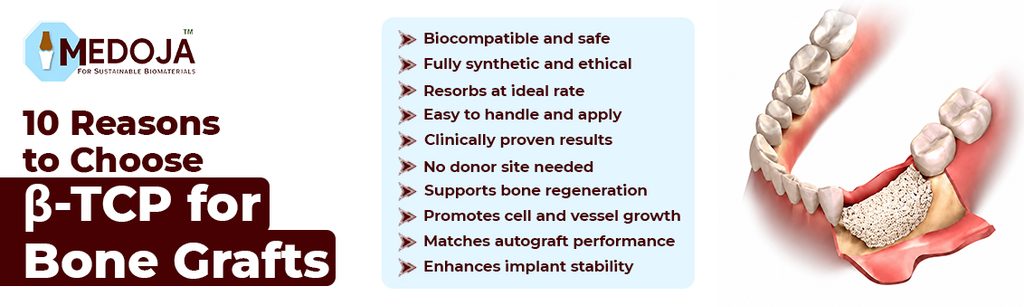
10 Reasons to Choose Beta-Tricalcium Phosphate (β-TCP) for Bone Grafts
Beta-Tricalcium Phosphate (β-TCP) has become an important synthetic bone graft material in modern dental and orthopaedic procedures.
As a biocompatible, bioactive, and resorbable calcium phosphate ceramic, β-TCP offers several advantages for bone regeneration and repair. Moreover, it supports the formation of new bone as it gradually resorbs. Therefore, β-TCP is widely used in dental procedures, including ridge augmentation, sinus lifts, socket preservation, and implant site development. In addition, it is suitable for treating various orthopaedic bone defects.
For clinicians looking for a reliable dental bone graft material, β-TCP offers a combination of safety, versatility, controlled resorption, and excellent osteoconductive properties.
Here are 10 key reasons to consider β-TCP for bone grafting procedures:
1. Excellent Biocompatibility and Safety
β-TCP is well tolerated by the body and is designed to support natural bone healing without causing significant adverse tissue reactions. Its calcium and phosphate composition is similar to the mineral components found naturally in bone. This makes it a suitable option for a variety of dental grafting materials and bone regeneration procedures.
2. A Fully Synthetic Alternative
β-TCP is manufactured synthetically under controlled conditions, eliminating the need for human or animal-derived tissue. This provides a standardized and consistent alternative to autografts, allografts, and xenografts. Its synthetic origin can also help address concerns related to animal-derived materials, disease transmission, and material variability.
3. Provides an Osteoconductive Framework
One of the major benefits of β-TCP is its osteoconductive nature. It provides a three-dimensional framework that supports the attachment and migration of bone-forming cells. This scaffold helps create a favorable environment for new bone formation and contributes to the natural regeneration process.
4. Controlled and Predictable Resorption
β-TCP is designed to gradually resorb as new bone develops. Its resorption allows the graft material to be progressively replaced by newly formed natural bone. In particular, this balance between material degradation and bone formation is valuable in dental bone grafting for implants, where maintaining adequate bone volume is essential.
5. Versatile Forms and Easy Handling
β-TCP can be supplied in different forms, including granules, powders, and moldable formulations. This versatility allows clinicians to select a suitable format based on the size, shape, and location of the bone defect. It can also be combined with autologous bone or other regenerative materials when clinically appropriate.
6. Wide Range of Dental Applications
β-TCP has been extensively investigated and used in various dental applications. These include ridge preservation, ridge augmentation, periodontal defect treatment, sinus augmentation, socket preservation, and implant-related bone regeneration. Its broad application range makes it a valuable material among modern graft materials in dentistry.
7. No Secondary Donor-Site Surgery
Autogenous bone grafting requires harvesting bone from another part of the patient’s body. This creates an additional surgical site and may contribute to postoperative discomfort and complications. β-TCP does not require a donor site, potentially reducing surgical complexity, patient morbidity, and recovery associated with bone harvesting.
8. Porous Structure Supports Bone Regeneration
The porous and interconnected structure of β-TCP can provide space for cellular infiltration and vascular development. This architecture creates a favorable environment for tissue ingrowth and new bone formation. Proper porosity and interconnected pores are important characteristics when designing an effective synthetic bone graft material for dental applications.
9. Strong Scientific Support as an Alternative to Autografts
Autografts remain an important reference material because they provide osteogenic, osteoinductive, and osteoconductive properties. In contrast, β-TCP offers effective osteoconductive support without requiring additional bone harvesting. Additionally, research comparing β-TCP with autograft bone grafting demonstrates its usefulness in several regenerative applications. As a result, β-TCP may serve as a suitable alternative when sufficient osteoconduction is the primary clinical requirement.
10. Valuable for Dental Implant Procedures
Successful dental implant placement requires adequate bone volume and quality. Clinicians can use β-TCP to develop implant sites and manage certain bone defects. As a result, β-TCP helps create a suitable environment for future implant placement. Its combination of osteoconductivity, resorbability, and biocompatibility makes it an important option in modern implantology.
Conclusion
Beta-Tricalcium Phosphate (β-TCP) offers a practical combination of biocompatibility, osteoconductivity, controlled resorption, synthetic composition, and clinical versatility. From ridge preservation and sinus augmentation to implant site development and periodontal regeneration, it can support a wide range of bone regeneration procedures.
For dental and orthopaedic professionals seeking a reliable synthetic bone graft material, β-TCP represents a well-established biomaterial that can support predictable bone regeneration while avoiding the need for a secondary donor site. Its continued use and development highlight the important role of calcium phosphate ceramics in modern regenerative medicine.