
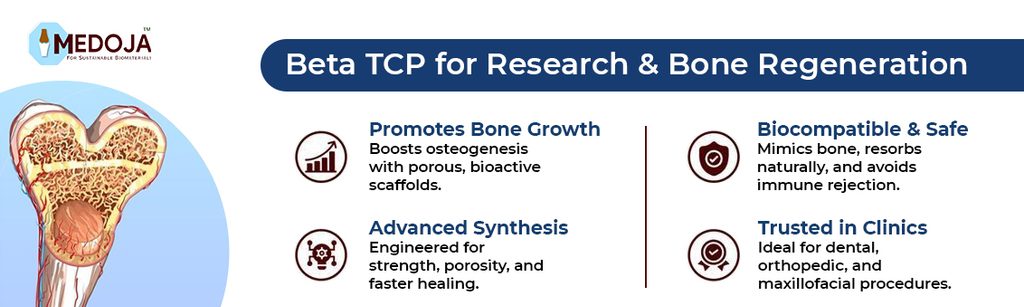
Beta TCP for Research & Bone Regeneration
In the dynamic field of biomaterials and regenerative medicine, Beta-Tricalcium Phosphate (β-TCP) has emerged as a frontrunner in synthetic bone substitutes. Its rise in both academic research and clinical practice underscores its remarkable potential in osteogenesis and bone healing. As the demand for safe, biocompatible, and effective bone regeneration materials grows, β-TCP stands out due to its biological properties and versatility.
Understanding Beta-Tricalcium Phosphate (β-TCP)
β-TCP is a calcium phosphate ceramic that combines calcium and phosphate in a stoichiometric ratio closely resembling the mineral component of natural bone. This resemblance plays a pivotal role in its acceptance by the body, making it highly biocompatible. Its chemical formula, Ca3(PO4)2, lends itself to a structure that is both porous and resorbable, setting it apart from other synthetic bone substitutes.
β-TCP and Osteogenesis
One of the most promising applications of β-TCP is its ability to support osteogenesis, the process of new bone formation. The porous architecture of β-TCP scaffolds allows for cellular infiltration, vascularization, and the gradual ingrowth of bone tissue. Unlike inert materials, β-TCP degrades over time, releasing calcium and phosphate ions that stimulate osteoblastic activity and promote the natural bone remodelling process. Moreover, β-TCP does not just passively support bone growth; it actively participates in it. Studies have demonstrated that β-TCP enhances the proliferation and differentiation of mesenchymal stem cells into osteoblasts, which are essential for new bone formation.
Biocompatibility and Safety Profile
β-TCP biocompatibility is one of its strongest advantages. It elicits minimal inflammatory response and integrates well with the host tissue. Its resorbable nature allows the body to replace the material with natural bone as it gradually degrades, reducing the need for additional surgeries or graft removal. This makes it an attractive option in both dental and orthopaedic applications, where patient safety and recovery are paramount. Compared to autografts (bone harvested from the patient’s own body) and allografts (donor bone), β-TCP eliminates the risks of donor site morbidity, disease transmission, and immune rejection. These benefits have propelled its widespread use in clinical bone grafting procedures.
Synthesis Methods of β-TCP
The performance of β-TCP in bone regeneration depends heavily on the method of synthesis. Researchers have developed various β-TCP synthesis methods to optimize its microstructure, porosity, and bioactivity:
Solid-State Reaction
This traditional method involves high-temperature sintering of calcium and phosphate compounds. It’s widely used for its simplicity and scalability.
Wet Chemical Precipitation
Produces nano-sized β-TCP particles with improved surface area and bioactivity, enhancing cell interaction.
Hydrothermal Methods
Allow for better control over crystal size and phase purity.
Sol-Gel Techniques
Enable the production of highly uniform and porous scaffolds, suitable for advanced applications in tissue engineering.
Each synthesis technique affects the final properties of the β-TCP scaffold, influencing its degradation rate, mechanical strength, and compatibility with biological tissues.
Scaffold Applications of β-TCP
The utility of β-TCP scaffold applications in tissue engineering cannot be overstated. Its highly porous structure is ideal for use as a scaffold in bone tissue engineering, allowing for:
Osteoconduction
Guiding the growth of new bone along the surface of the scaffold.
Cellular Infiltration
Promoting migration and attachment of osteoprogenitor cells.
Drug Delivery
β-TCP can serve as a carrier for growth factors and antibiotics, offering multifunctionality in healing complex bone defects.
In recent years, researchers have explored composite scaffolds combining β-TCP with polymers like collagen or poly(lactic-co-glycolic acid) (PLGA) to improve flexibility, bioactivity, and degradation control.
Role in Bone Regeneration
As a bone regeneration material, β-TCP plays an important role in orthopedics, maxillofacial surgery, dental implants, and spinal fusion procedures.Its resorbable nature means it doesn’t require a second surgery for removal, a key advantage over metallic implants. Moreover, its mechanical properties are suitable for non-load-bearing and low-load-bearing sites, making it ideal for craniofacial and dental applications. Clinical evidence shows that β-TCP accelerates the healing of bone defects, reduces recovery time, and improves overall patient outcomes. Clinicians often use β-TCP in combination with autologous bone or stem cells to enhance its regenerative effects.
Synthetic Bone Substitutes: The Bigger Picture
In the broader landscape of synthetic bone substitutes, β-TCP represents a paradigm shift toward materials that are not only structurally compatible with bone but also biologically active. Traditional materials such as PMMA (polymethylmethacrylate) or titanium lack this resorbable, osteogenic property. By contrast, β-TCP offers a smart, bioactive approach that harmonizes with the body’s natural healing mechanisms. As research continues to evolve, researchers are developing new generations of β-TCP-based materials with enhanced mechanical strength, tailored degradation rates, and smart functionalities such as pH responsiveness and bioactive molecule release.
The Future of β-TCP in Regenerative Medicine
The future looks bright for β-TCP. With advances in 3D printing and biofabrication, researchers can now create personalized β-TCP implants that fit patient-specific defects. Smart β-TCP composites that release growth factors or respond to physiological stimuli are under development, offering promising directions for complex and critical bone repair scenarios. As the global demand for effective bone graft substitutes grows due to aging populations, trauma cases, and orthopaedic surgeries, β-TCP can play a leading role in bone tissue engineering. It not only meets the current clinical requirements but also aligns with future innovations in personalized and regenerative medicine.
A Vital Tool in Bone Healing
Beta-tricalcium phosphate bone grafts exemplify the intersection of biocompatibility, structural support, and regenerative capability. As one of the most promising bone regeneration materials, β-TCP continues to shape the future of orthopaedic and dental healing. From basic synthesis methods to advanced scaffold applications, its role in enhancing osteogenesis and offering reliable, synthetic bone substitutes is invaluable. In the coming years, as technologies converge and biological understanding deepens, β-TCP will likely play an even more integral role in ensuring safer, faster, and more complete bone healing outcomes for patients worldwide.