MedoSirā Calcium-Deficient
Apatite Bone Graft.
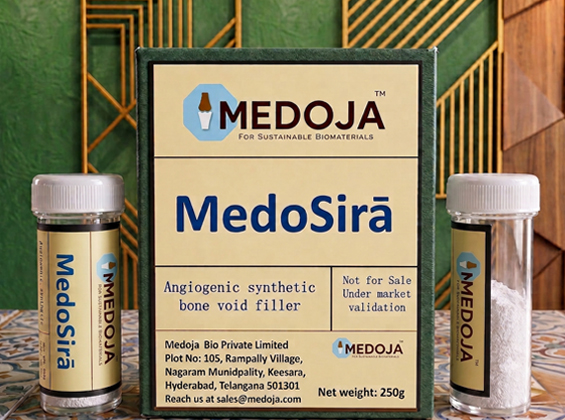
A pioneering angiogenic bone graft featuring Calcium-Deficient Apatite co-doped with strontium and magnesium ions. Available as granules for standard procedures or as a 3D-printable ceramic ink for patient-specific, bespoke solutions.
- Patent No. 589869 — Granted by IPO, India
- Customizable Sr²⁺ & Mg²⁺ doped CDA material
- Angiogenic · Biocompatible & Osteoconductive
- 3D-Printable ceramic ink for bespoke scaffolds
- Made by Medoja Bio Pvt. Ltd.
A pioneering bone graft built for the future.
Medoja Bio has developed MedoSirā — a Calcium-Deficient Apatite bone graft co-doped with strontium (Sr²⁺) and magnesium (Mg²⁺) ions. This angiogenic graft actively promotes blood vessel formation alongside bone regeneration, setting a new standard in bone tissue engineering.
Available as ready-to-use granules for standard procedures or as a 3D-printable ceramic ink for patient-specific scaffolds — giving clinicians full control over both external shape and internal architecture. Protected under Indian Patent No. 589869, granted by the Government of India.
Officially Granted Patent Protection
Our CDA-based angiogenic bone graft is protected under Indian Patent No. 589869, granted by The Patent Office, Government of India, in accordance with the provisions of the Patents Act, 1970.
CDA Bone Graft for Vascular & Bone Regeneration
Vascular Integration, Not Just Osteoconduction
Unlike conventional grafts that focus primarily on osteoconduction, our CDA formulation emphasizes vascular integration as a critical component of successful bone regeneration. The graft is designed to actively recruit and support blood vessel formation rather than passively waiting for it to occur around the implant site.
Sr²⁺ and Mg²⁺ Microenvironment
The co-doped elemental ions — strontium (Sr²⁺) and magnesium (Mg²⁺) — help create a microenvironment conducive to rapid blood vessel formation and nutrient delivery, accelerating the healing process. This intrinsic angiogenic activity sets MedoSirā apart from passive ceramic grafts.
Holistic Bone Regeneration
This holistic approach — encompassing tailored structural geometry, enhanced osteogenesis, and active angiogenesis — empowers surgeons and clinicians with a next-generation graft material designed to address both functional and biological demands for optimal patient outcomes.
How MedoSirā Bone Graft Works
Implantation
Granules or printed scaffold placed at the bone defect site with controlled internal architecture.
Ion Release
Sr²⁺ and Mg²⁺ ions release locally, signaling cells and supporting cellular activity.
Angiogenesis
New blood vessels form into the scaffold, delivering nutrients to growing tissue.
Bone Formation
Osteogenic activity builds new bone tissue, integrating with the host bone structure.
Two Delivery Formats for Surgeons & Clinicians
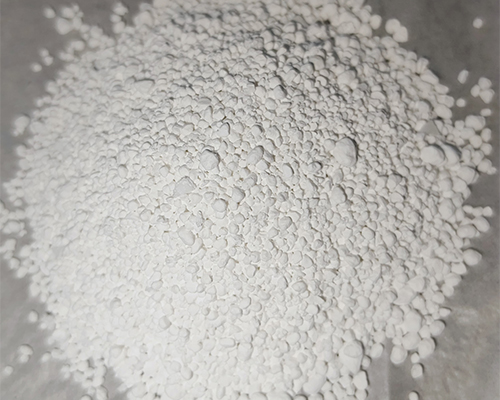
MedoSirā is engineered to fit two clinical workflows. As standard granules, it integrates into established bone graft procedures with minimal disruption to existing surgical practice — a drop-in upgrade with angiogenic benefits.
As a 3D-printable ceramic ink, the same CDA composition can be formed into patient-specific implants. By leveraging ceramic 3D printing, we achieve meticulous control over both external and internal architectures — enabling porous geometries that promote bone ingrowth and vascular development.
This dual-format approach gives clinicians flexibility — choose granules for conventional cases, choose printed scaffolds for complex bone defects requiring bespoke geometry. The biological performance is consistent across both formats.
Granules — Standard Procedures
Ready-to-use granules integrate into conventional bone graft workflows. Suitable for fills, augmentation, and ridge preservation procedures.
3D-Printable Ink — Bespoke Scaffolds
Ceramic 3D-printing-ready ink enables patient-specific scaffold geometry with controlled internal porosity for complex defects.
Ceramic 3D Printing for Patient-Specific Architectures
By leveraging ceramic 3D printing, our CDA-based graft moves beyond the limits of off-the-shelf bone substitutes. Surgeons can specify both the external shape and the internal porous architecture of the scaffold, matching the geometry of each individual defect rather than forcing the defect to fit a generic product.
Controlled internal architecture matters because bone regeneration is not just a chemistry problem — it is a transport problem. The right pore size and connectivity allow cells to migrate inward, blood vessels to form, and nutrients to reach the growing tissue. MedoSirā's printable format gives clinicians control over these variables.
The synergy of intrinsic osteogenic and angiogenic properties, combined with customizable design, establishes our CDA-based graft as a superior choice for bone tissue engineering and treating complex bone defects that conventional grafts struggle to address.
Where MedoSirā Advances Bone Regeneration
Our CDA bone graft material has been engineered to support a range of clinically relevant scenarios where conventional grafts fall short. Research and development focus areas include:
Complex Bone DefectsReconstructive Surgery
Patient-specific 3D-printed scaffolds for complex bone defects where standard granule grafts cannot match defect geometry.
Vascularized RegenerationAngiogenic Healing
Sr²⁺ and Mg²⁺ doping creates a microenvironment that actively supports blood vessel formation alongside new bone tissue.
Bone Tissue EngineeringScaffold-Based Therapies
Controlled internal porosity supports cell migration, nutrient transport, and progressive bone ingrowth into the scaffold.
The combination of intrinsic osteogenic activity, active angiogenesis, and customizable structural design positions MedoSirā as a next-generation graft material designed to address both the functional and biological demands of optimal patient outcomes.
The Future of Bone Grafting with Doped CDA
With continued research and clinical engagement, MedoSirā is positioned to shift bone grafting from passive osteoconduction toward an active, vascular-aware regenerative approach. The roadmap ahead focuses on three areas:
Clinical Validation Programmes
Structured clinical engagement to validate CDA granules in established bone graft procedures.
Bespoke Scaffold Workflows
Surgeon-facing workflows for patient-specific scaffold design, printing, and delivery.
Wider Indication Studies
Extension into complex bone defects, dental, orthopaedic, and maxillofacial applications.
With patent protection secured and the platform technology validated, the next phase of MedoSirā focuses on translation — moving from a patented material innovation to a routine clinical option for sustainable biomaterials in bone regeneration.
Frequently Asked Questions
01 What makes MedoSirā different from a conventional bone graft?
Most ceramic bone grafts rely on osteoconduction — they provide a passive scaffold and wait for the body to do the rest. MedoSirā is different: the Calcium-Deficient Apatite is co-doped with strontium (Sr²⁺) and magnesium (Mg²⁺), which actively support angiogenesis (blood vessel formation) alongside bone formation. Vascular integration is treated as a core part of regeneration, not an afterthought.
02 What does "Patent No. 589869" cover, and where is it valid?
Indian Patent No. 589869 was granted by The Patent Office, Government of India, on 20 May 2026, with a 20-year term from the filing date of 3 March 2025. It covers the invention titled "Sr²⁺ and Mg²⁺ Doped Calcium-Deficient Apatite (CDA) as an Angiogenic and Customizable Bespoke Bone Graft", and is held by Medoja Bio Private Limited. The grant is in accordance with the provisions of The Patents Act, 1970.
03 Is MedoSirā available as granules, as a 3D-printable ink, or both?
Both. The same CDA composition is available in two formats: ready-to-use granules for standard bone graft applications, and a ceramic 3D-printable ink for patient-specific scaffolds. Granules suit conventional procedures; the printable ink suits complex defects where bespoke external shape and internal porosity matter. Clinicians can select the format that fits the case.
04 Why are strontium and magnesium specifically used as dopants?
Sr²⁺ and Mg²⁺ were selected because they create a local microenvironment that supports two outcomes at once — bone formation and blood vessel development. The released ions help promote rapid vascular ingrowth and nutrient delivery to the regenerating tissue, which speeds the healing process. This dual osteogenic-angiogenic effect is the basis of the patented innovation.
05 How do I request a sample, pricing, or licensing information?
MedoSirā is currently a pipeline product (B2C) at Medoja Bio Private Limited. Use the quote form below to share your clinical or research interest, organisation, and intended volume — our team will respond within 24 hours with sample availability, pricing, and, where relevant, licensing options associated with Patent No. 589869.
Request a Quote
Fill in the details and we'll respond within 24 hours.
Quote Request Sent!
Thank you. Our team will get back to you within 24 hours with pricing and availability.
MedoSirā Calcium-Deficient
Apatite Bone Graft.
A pioneering angiogenic bone graft featuring Calcium-Deficient Apatite co-doped with strontium and magnesium ions. Available as granules for standard procedures or as a 3D-printable ceramic ink for patient-specific, bespoke solutions.
- Patent No. 589869 — Granted by IPO, India
- Customizable Sr²⁺ & Mg²⁺ doped CDA material
- Angiogenic · Biocompatible & Osteoconductive
- 3D-Printable ceramic ink for bespoke scaffolds
- Made by Medoja Bio Pvt. Ltd.
A pioneering bone graft built for the future.
Medoja Bio has developed MedoSirā — a Calcium-Deficient Apatite bone graft co-doped with strontium (Sr²⁺) and magnesium (Mg²⁺) ions. This angiogenic graft actively promotes blood vessel formation alongside bone regeneration, setting a new standard in bone tissue engineering.
Available as ready-to-use granules for standard procedures or as a 3D-printable ceramic ink for patient-specific scaffolds — giving clinicians full control over both external shape and internal architecture. Protected under Indian Patent No. 589869, granted by the Government of India.
Officially Granted Patent Protection
Our CDA-based angiogenic bone graft is protected under Indian Patent No. 589869, granted by The Patent Office, Government of India, in accordance with the provisions of the Patents Act, 1970.
CDA Bone Graft for Vascular & Bone Regeneration
Vascular Integration, Not Just Osteoconduction
Unlike conventional grafts that focus primarily on osteoconduction, our CDA formulation emphasizes vascular integration as a critical component of successful bone regeneration. The graft is designed to actively recruit and support blood vessel formation rather than passively waiting for it to occur around the implant site.
Sr²⁺ and Mg²⁺ Microenvironment
The co-doped elemental ions — strontium (Sr²⁺) and magnesium (Mg²⁺) — help create a microenvironment conducive to rapid blood vessel formation and nutrient delivery, accelerating the healing process. This intrinsic angiogenic activity sets MedoSirā apart from passive ceramic grafts.
Holistic Bone Regeneration
This holistic approach — encompassing tailored structural geometry, enhanced osteogenesis, and active angiogenesis — empowers surgeons and clinicians with a next-generation graft material designed to address both functional and biological demands for optimal patient outcomes.
How MedoSirā Bone Graft Works
Implantation
Granules or printed scaffold placed at the bone defect site with controlled internal architecture.
Ion Release
Sr²⁺ and Mg²⁺ ions release locally, signaling cells and supporting cellular activity.
Angiogenesis
New blood vessels form into the scaffold, delivering nutrients to growing tissue.
Bone Formation
Osteogenic activity builds new bone tissue, integrating with the host bone structure.
Two Delivery Formats for Surgeons & Clinicians
MedoSirā is engineered to fit two clinical workflows. As standard granules, it integrates into established bone graft procedures with minimal disruption to existing surgical practice — a drop-in upgrade with angiogenic benefits.
As a 3D-printable ceramic ink, the same CDA composition can be formed into patient-specific implants. By leveraging ceramic 3D printing, we achieve meticulous control over both external and internal architectures — enabling porous geometries that promote bone ingrowth and vascular development.
This dual-format approach gives clinicians flexibility — choose granules for conventional cases, choose printed scaffolds for complex bone defects requiring bespoke geometry. The biological performance is consistent across both formats.
Granules — Standard Procedures
Ready-to-use granules integrate into conventional bone graft workflows. Suitable for fills, augmentation, and ridge preservation procedures.
3D-Printable Ink — Bespoke Scaffolds
Ceramic 3D-printing-ready ink enables patient-specific scaffold geometry with controlled internal porosity for complex defects.
Ceramic 3D Printing for Patient-Specific Architectures
By leveraging ceramic 3D printing, our CDA-based graft moves beyond the limits of off-the-shelf bone substitutes. Surgeons can specify both the external shape and the internal porous architecture of the scaffold, matching the geometry of each individual defect rather than forcing the defect to fit a generic product.
Controlled internal architecture matters because bone regeneration is not just a chemistry problem — it is a transport problem. The right pore size and connectivity allow cells to migrate inward, blood vessels to form, and nutrients to reach the growing tissue. MedoSirā's printable format gives clinicians control over these variables.
The synergy of intrinsic osteogenic and angiogenic properties, combined with customizable design, establishes our CDA-based graft as a superior choice for bone tissue engineering and treating complex bone defects that conventional grafts struggle to address.
Where MedoSirā Advances Bone Regeneration
Our CDA bone graft material has been engineered to support a range of clinically relevant scenarios where conventional grafts fall short. Research and development focus areas include:
Complex Bone DefectsReconstructive Surgery
Patient-specific 3D-printed scaffolds for complex bone defects where standard granule grafts cannot match defect geometry.
Vascularized RegenerationAngiogenic Healing
Sr²⁺ and Mg²⁺ doping creates a microenvironment that actively supports blood vessel formation alongside new bone tissue.
Bone Tissue EngineeringScaffold-Based Therapies
Controlled internal porosity supports cell migration, nutrient transport, and progressive bone ingrowth into the scaffold.
The combination of intrinsic osteogenic activity, active angiogenesis, and customizable structural design positions MedoSirā as a next-generation graft material designed to address both the functional and biological demands of optimal patient outcomes.
The Future of Bone Grafting with Doped CDA
With continued research and clinical engagement, MedoSirā is positioned to shift bone grafting from passive osteoconduction toward an active, vascular-aware regenerative approach. The roadmap ahead focuses on three areas:
Clinical Validation Programmes
Structured clinical engagement to validate CDA granules in established bone graft procedures.
Bespoke Scaffold Workflows
Surgeon-facing workflows for patient-specific scaffold design, printing, and delivery.
Wider Indication Studies
Extension into complex bone defects, dental, orthopaedic, and maxillofacial applications.
With patent protection secured and the platform technology validated, the next phase of MedoSirā focuses on translation — moving from a patented material innovation to a routine clinical option for sustainable biomaterials in bone regeneration.
Frequently Asked Questions
01 What makes MedoSirā different from a conventional bone graft?
Most ceramic bone grafts rely on osteoconduction — they provide a passive scaffold and wait for the body to do the rest. MedoSirā is different: the Calcium-Deficient Apatite is co-doped with strontium (Sr²⁺) and magnesium (Mg²⁺), which actively support angiogenesis (blood vessel formation) alongside bone formation. Vascular integration is treated as a core part of regeneration, not an afterthought.
02 What does "Patent No. 589869" cover, and where is it valid?
Indian Patent No. 589869 was granted by The Patent Office, Government of India, on 20 May 2026, with a 20-year term from the filing date of 3 March 2025. It covers the invention titled "Sr²⁺ and Mg²⁺ Doped Calcium-Deficient Apatite (CDA) as an Angiogenic and Customizable Bespoke Bone Graft", and is held by Medoja Bio Private Limited. The grant is in accordance with the provisions of The Patents Act, 1970.
03 Is MedoSirā available as granules, as a 3D-printable ink, or both?
Both. The same CDA composition is available in two formats: ready-to-use granules for standard bone graft applications, and a ceramic 3D-printable ink for patient-specific scaffolds. Granules suit conventional procedures; the printable ink suits complex defects where bespoke external shape and internal porosity matter. Clinicians can select the format that fits the case.
04 Why are strontium and magnesium specifically used as dopants?
Sr²⁺ and Mg²⁺ were selected because they create a local microenvironment that supports two outcomes at once — bone formation and blood vessel development. The released ions help promote rapid vascular ingrowth and nutrient delivery to the regenerating tissue, which speeds the healing process. This dual osteogenic-angiogenic effect is the basis of the patented innovation.
05 How do I request a sample, pricing, or licensing information?
MedoSirā is currently a pipeline product (B2C) at Medoja Bio Private Limited. Use the quote form below to share your clinical or research interest, organisation, and intended volume — our team will respond within 24 hours with sample availability, pricing, and, where relevant, licensing options associated with Patent No. 589869.
Request a Quote
Fill in the details and we'll respond within 24 hours.
Quote Request Sent!
Thank you. Our team will get back to you within 24 hours with pricing and availability.